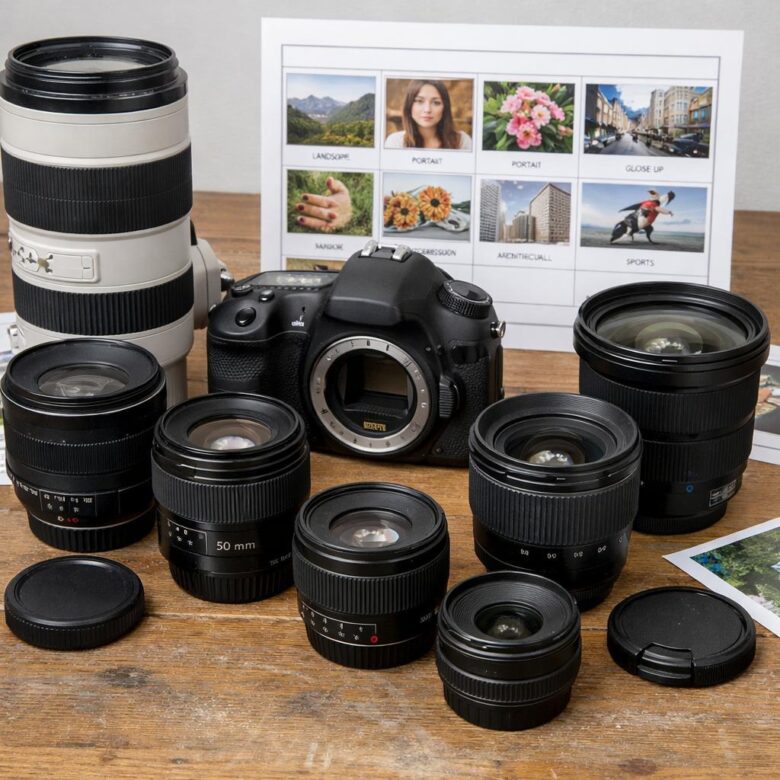
Choosing the right camera lens can completely change the way your photos look, even when you use the same camera body. A lens affects angle of view, background blur, sharpness, low-light performance, subject separation, and how close or far you need to stand from your subject.
For beginners, the biggest confusion is usually not about camera brands, but about lens types. Wide-angle lenses, prime lenses, zoom lenses, telephoto lenses, and macro lenses all serve different purposes, and the best choice depends on the photography style you want to practice.
The right camera lens for portraits is not always the best lens for landscapes. A lens that works beautifully for street photography may feel too limited for wildlife. A lens that is perfect for product photos may not be practical for travel if it is heavy, expensive, or too specialized.
This guide explains how to choose a lens based on real photography needs instead of confusing technical terms. You will learn what focal length means, when aperture matters, which lens types fit different photography styles, and what mistakes to avoid before spending money.
By the end, you should be able to compare lenses with more confidence and build a simple lens setup that matches your style, budget, and level of experience.
Important note: before buying a camera lens, always confirm compatibility with your camera mount, sensor size, autofocus system, and brand requirements. A lens may look suitable online but still fail to work correctly with your camera body.
Understanding the Basic Lens Terms Before You Choose
Before comparing specific lenses, it helps to understand a few basic terms. The most important one is focal length, usually shown in millimeters, such as 24mm, 35mm, 50mm, 85mm, or 200mm. A smaller number gives a wider view, while a larger number brings distant subjects closer.
Aperture is another key factor. It is written as f/1.8, f/2.8, f/4, and similar values. A lower f-number lets in more light and can create stronger background blur. This is useful for portraits, indoor photography, events, and low-light situations.
You should also pay attention to whether the lens is a prime or zoom lens. A prime lens has one fixed focal length, while a zoom lens covers a range. In practice, prime lenses are often lighter and brighter, while zoom lenses are more flexible for travel, events, and unpredictable scenes.
| Lens term | What it means | Why it matters |
|---|---|---|
| Focal length | The angle of view and how close the subject appears. | Helps you choose between wide landscapes, portraits, sports, or wildlife. |
| Aperture | How much light the lens can let in. | Affects low-light performance and background blur. |
| Prime lens | A lens with one fixed focal length. | Often sharp, bright, simple, and good for learning composition. |
| Zoom lens | A lens with multiple focal lengths in one body. | Useful when you need flexibility and cannot change lenses often. |
| Image stabilization | A feature that reduces blur from small hand movements. | Helpful for handheld shooting, video, travel, and slower shutter speeds. |
Best Camera Lens Choices for Portrait Photography
Portrait photography usually benefits from lenses that create natural-looking faces and separate the subject from the background. For many photographers, lenses around 50mm, 85mm, or 135mm are popular because they avoid extreme distortion and help create a flattering perspective.
A 50mm lens is often a smart first choice because it is usually affordable, lightweight, and useful in many situations. It works well for casual portraits, family photos, lifestyle images, and beginner photography. On some crop-sensor cameras, a 50mm lens may feel tighter indoors, so space matters.
An 85mm lens is often preferred for classic portraits because it gives stronger subject separation and a more compressed background. However, it requires more working distance. In a small room, it may feel too tight.Many beginners buy an 85mm lens without realizing they need enough space to step back.
- Choose a 50mm lens if you want an affordable and flexible portrait option.
- Choose an 85mm lens if you want stronger background blur and have enough space.
- Look for a wide aperture such as f/1.8 or f/2.8 if you shoot in low light.
- Avoid ultra-wide lenses for close-up portraits because they can distort faces.
- Check autofocus performance if you photograph children, events, or moving people.
Best Lenses for Landscape and Travel Photography
Landscape photography usually needs a wider field of view so you can capture mountains, beaches, cities, forests, skies, and large scenes. Wide-angle lenses such as 16mm, 20mm, 24mm, or zooms like 16-35mm are common choices for this style.
For travel photography, flexibility matters more than having the most specialized lens. A zoom lens such as 24-70mm, 24-105mm, or an equivalent range for crop-sensor cameras can cover landscapes, street scenes, food, architecture, and casual portraits without changing lenses constantly.
A common mistake is buying the widest lens possible and expecting every landscape photo to look better. Very wide lenses can make scenes look empty if there is no strong foreground. Before using an ultra-wide lens, think about what will lead the viewer’s eye through the image.
| Photography style | Useful lens range | Main advantage |
|---|---|---|
| Landscape | 16mm to 35mm | Captures wide scenes, skies, architecture, and natural environments. |
| Travel | 24mm to 105mm | Offers flexibility for many subjects without carrying too much gear. |
| Street photography | 28mm, 35mm, or 50mm | Feels natural, discreet, and practical for daily scenes. |
| Portraits | 50mm to 135mm | Helps separate the subject and create flattering perspective. |
| Wildlife and sports | 200mm to 600mm | Brings distant subjects closer without disturbing the scene. |
Choosing a Lens for Street Photography
Street photography is about timing, observation, and reacting quickly to everyday moments. Lenses around 28mm, 35mm, and 50mm are common because they feel natural and allow you to include people, buildings, movement, and context in the same frame.
A 35mm lens is often considered one of the most balanced choices for street photography. It is wide enough to show the environment but not so wide that everything feels distant. It also encourages you to move, observe, and compose carefully instead of relying only on zoom.
A 50mm lens can work well when you want a tighter, more focused street style. It helps isolate details, expressions, signs, and small moments. However, it may be less practical in crowded areas where you cannot step back easily.
-
Start with your shooting distance.
If you like being close to the scene, a 28mm or 35mm lens may feel natural. If you prefer more distance, a 50mm lens can be more comfortable.
-
Think about how much background you want.
Street photos often need context. A lens that is too tight may remove useful details that explain the story of the image.
-
Choose a lightweight setup.
Heavy lenses can make you tired and less discreet. A smaller lens often helps you move faster and photograph more naturally.
-
Check autofocus and manual control.
Fast autofocus helps with moving subjects, but simple manual controls can also be useful when you want to pre-focus in a busy location.
-
Practice before buying more lenses.
Use one focal length for a few weeks. This helps you understand your style before spending money on another lens.
Best Lens Options for Wildlife, Sports, and Action
Wildlife and sports photography usually require telephoto lenses because the subject is often far away or moving quickly. Common options include 70-200mm, 100-400mm, 150-600mm, and similar ranges depending on camera brand and budget.
For indoor sports, aperture becomes very important. A 70-200mm f/2.8 lens is popular because it gathers more light and can freeze action better in gyms, arenas, and low-light venues. For outdoor wildlife, longer reach may matter more than a very wide aperture.
In many cases, beginners underestimate the importance of autofocus speed. A long lens is not enough if the camera and lens cannot track movement well. Birds, athletes, pets, and vehicles require a lens that focuses reliably, not just one with a large zoom number.
- Choose at least 200mm for field sports, wildlife, or distant subjects.
- Consider 400mm or longer for birds and small wildlife.
- Prioritize autofocus performance for fast-moving subjects.
- Look for stabilization if you shoot handheld with long lenses.
- Check lens weight before buying, especially if you plan to walk for long periods.
- Use a monopod or tripod when the lens becomes too heavy for stable handheld shots.
Macro and Product Photography Lens Choices
Macro photography is used for close-up images of small subjects such as insects, flowers, jewelry, textures, and product details. A true macro lens usually offers close focusing and high magnification, often marked as 1:1 magnification.
For product photography, macro lenses can be useful even when you are not photographing tiny objects. They are often sharp, controlled, and good for details. A 60mm, 90mm, or 100mm macro lens can work well depending on the space you have and the size of the product.
One practical issue with macro photography is working distance. If you are too close to the subject, you may block light or scare insects. A longer macro lens gives more distance, while a shorter macro lens may be easier to use indoors for controlled product photos.
| Lens type | Best use | Important caution |
|---|---|---|
| 60mm macro | Small products, food details, indoor close-ups. | May require getting very close to the subject. |
| 90mm or 100mm macro | Flowers, insects, jewelry, detailed product photos. | Can be more expensive and may need careful focusing. |
| Telephoto zoom | Products from a distance, compressed backgrounds, larger items. | Usually not a true macro lens unless specified. |
| Standard prime | Simple product photos and lifestyle images. | May not focus close enough for small details. |
Prime Lens vs Zoom Lens: Which One Should Beginners Choose?
A prime lens is a strong choice when you want better low-light performance, sharper images, and a simple learning experience. Because it does not zoom, it forces you to move and think more carefully about composition. This can improve your photography habits over time.
A zoom lens is better when you need flexibility. Travel, weddings, events, family outings, and journalism-style photography often move quickly. In those situations, changing your position or switching lenses may not be practical, so a zoom lens can help you capture more moments.
For many beginners, the safest path is to start with a useful zoom lens and add one bright prime lens later. For example, a standard zoom can handle daily situations, while a 50mm f/1.8 prime can help with portraits, low light, and learning depth of field.
| Option | When it makes sense | Possible limitation |
|---|---|---|
| Prime lens | You want sharpness, low-light performance, and background blur. | You must move physically because there is no zoom. |
| Zoom lens | You need flexibility for travel, events, and changing scenes. | May be heavier, more expensive, or have a smaller maximum aperture. |
| Kit lens | You are learning basics and do not know your favorite style yet. | May struggle in low light and may not create strong background blur. |
| Professional zoom | You shoot paid work, events, or demanding situations. | Often heavier and more expensive than beginner lenses. |
Common Mistakes When Buying a Camera Lens
One of the most common mistakes is buying a lens only because another photographer recommends it. A lens can be excellent and still be wrong for your camera, space, budget, or photography style. The best lens is the one that solves your real shooting problem.
Another mistake is ignoring sensor size. A 50mm lens does not feel exactly the same on a full-frame camera and a crop-sensor camera. On crop sensors, the field of view becomes tighter, which can affect portraits, indoor photos, travel, and street photography.
Many beginners also focus only on background blur. While blur can look beautiful, it is not the only sign of a good photo. Composition, light, timing, color, focus accuracy, and storytelling matter just as much as the maximum aperture of the lens.
| Common mistake | Consequence | Better approach |
|---|---|---|
| Buying only for low f-number | The lens may be expensive or difficult to use wide open. | Balance aperture with autofocus, weight, and real use. |
| Ignoring camera mount | The lens may not fit or may need an adapter. | Confirm compatibility with the camera brand and mount. |
| Choosing too much zoom | The lens may be heavy, soft, or slow in low light. | Choose a range that matches your actual photography style. |
| Forgetting about weight | You may avoid using the lens because it is uncomfortable. | Check size and weight before buying, especially for travel. |
| Copying professionals too early | You may spend too much before understanding your needs. | Practice with basic lenses before upgrading. |
How to Build a Simple Lens Kit for Different Photography Styles
You do not need many lenses to take strong photos. A simple kit can cover most needs if each lens has a clear purpose. Instead of buying several similar lenses, choose options that give you different creative possibilities.
A practical beginner kit might include a standard zoom lens, a bright prime lens, and one specialized lens based on your favorite style. For example, a travel photographer may add a wide-angle lens, while a wildlife photographer may add a telephoto lens.
Before upgrading, review your own photos. Check which focal lengths you use most, where your current lens feels limited, and what kind of image you keep failing to capture. This is usually more reliable than buying based only on online reviews.
- Keep your current lens until you clearly understand its limitation.
- Buy a new lens to solve a specific problem, not just to collect gear.
- Choose one flexible lens for general use.
- Add one bright prime lens if you shoot portraits or low-light scenes.
- Add a specialized lens only when your style requires it.
- Rent or borrow expensive lenses before buying when possible.
When to Ask for Professional Help or Official Support
You should contact the camera manufacturer, an authorized store, or professional support when you are unsure about lens compatibility. This is especially important for mirrorless systems, older DSLR lenses, adapters, autofocus limitations, and third-party lenses.
Professional help is also useful if your lens appears soft, focuses inconsistently, makes unusual noises, or does not communicate correctly with the camera. Sometimes the problem is not the lens choice, but calibration, firmware, settings, or physical damage.
If you plan to photograph paid events, weddings, commercial products, or professional portraits, it may be worth speaking with experienced photographers before investing in expensive lenses. Paid work often requires reliability, backup gear, and lenses that perform well under pressure.
Conclusion
The right camera lens depends on what you photograph most, how much control you need, and where your current gear feels limited. Portraits, landscapes, street photography, wildlife, sports, macro, travel, and product photography all benefit from different focal lengths and lens features.
For most beginners, the smartest choice is not the most expensive lens, but the lens that matches a real photography style. A standard zoom plus one bright prime lens can be a strong starting point before moving into wide-angle, telephoto, or macro lenses.
Before buying, confirm compatibility, compare weight, check aperture, review your actual shooting habits, and look for official support when needed. Choosing the right camera lens becomes much easier when you focus on practical use instead of marketing terms.
FAQ
1. What is the best first camera lens for beginners?
The best first camera lens for many beginners is usually a standard zoom lens or an affordable 50mm prime lens. A standard zoom gives flexibility for travel, family photos, landscapes, and everyday subjects. A 50mm prime is often sharper, brighter, and useful for portraits and low-light scenes. The better choice depends on how you shoot. If you still do not know your favorite photography style, start with a flexible zoom. If you already enjoy portraits or creative background blur, a bright prime lens can be a smart first upgrade.
2. Is a prime lens better than a zoom lens?
A prime lens is not always better than a zoom lens; it is simply different. Prime lenses often offer wider apertures, lighter designs, and strong image quality for the price. They are excellent for portraits, street photography, low light, and learning composition. Zoom lenses are better when you need flexibility, such as during travel, events, sports, or family activities. The best option depends on your situation. Many photographers use both because a prime lens gives creative control while a zoom lens helps when the subject distance changes quickly.
3. What lens should I use for portrait photography?
For portrait photography, common choices include 50mm, 85mm, and 135mm lenses. A 50mm lens is affordable and flexible, making it good for beginners and casual portraits. An 85mm lens is often preferred for more flattering portraits with stronger background separation. A 135mm lens can create beautiful compression but requires more space. If you shoot indoors, make sure the lens is not too tight for your room. A wide aperture, such as f/1.8 or f/2.8, can also help in low light and create softer backgrounds.
4. What lens is best for landscape photography?
Landscape photography often works well with wide-angle lenses, such as 16mm, 20mm, 24mm, or zoom lenses like 16-35mm. These lenses help capture broad scenes, skies, mountains, beaches, and architecture. However, the widest lens is not always the best choice. Very wide lenses can make distant subjects look smaller and may leave empty space if the composition is weak. A standard zoom can also work well for landscapes, especially when you want to isolate details, mountains, trees, or patterns instead of capturing everything.
5. Do I need an expensive lens to take good photos?
No, you do not need an expensive lens to take good photos. Light, composition, timing, subject choice, and editing often matter more than price. A basic kit lens can produce strong images when used carefully. An affordable prime lens can also deliver excellent quality for portraits, street photography, and low-light scenes. Expensive lenses usually offer better build quality, faster autofocus, wider apertures, or weather sealing, but they do not automatically make better photos. Upgrade only when your current lens clearly limits what you want to create.
6. What does focal length mean in simple terms?
Focal length describes how wide or narrow the lens view appears. It is measured in millimeters. A small number, such as 16mm or 24mm, gives a wide view and is useful for landscapes, interiors, and architecture. A medium number, such as 35mm or 50mm, feels more natural and works well for street photography, travel, and portraits. A larger number, such as 200mm or 400mm, brings distant subjects closer and is useful for wildlife, sports, and action. Focal length strongly affects composition and working distance.
7. What aperture should I choose for photography?
The best aperture depends on the type of photo you want. A wide aperture, such as f/1.8 or f/2.8, lets in more light and creates stronger background blur. This is useful for portraits, indoor photos, and low-light scenes. A smaller aperture, such as f/8 or f/11, keeps more of the scene in focus and is often used for landscapes, architecture, and product photos. Lens aperture matters when buying because some lenses allow wider apertures than others, but technique and lighting are still very important.
8. What lens should I use for street photography?
Street photography often works well with 28mm, 35mm, or 50mm lenses. A 35mm lens is a balanced option because it captures people and surroundings without feeling too wide. A 28mm lens is useful when you want more environment in the frame or shoot in tight spaces. A 50mm lens works better when you prefer isolating details or photographing from a bit more distance. The best street lens should be comfortable, lightweight, and quick to use because timing matters more than carrying a large setup.
9. What lens is best for wildlife photography?
Wildlife photography usually requires a telephoto lens because animals are often far away and should not be disturbed. Lenses around 300mm, 400mm, 500mm, or 600mm are common for birds and distant wildlife. A 100-400mm or 150-600mm zoom can be practical because it gives flexibility when the subject moves. Autofocus performance and stabilization are also important. A long lens is useful, but it must focus reliably and be manageable in weight, especially if you walk, hike, or shoot handheld for long periods.
10. Can I use one lens for every photography style?
You can use one lens for many photography styles, but no single lens is perfect for everything. A standard zoom lens can handle travel, family photos, landscapes, casual portraits, and daily scenes. However, it may not be ideal for wildlife, serious macro photography, indoor sports, or portraits with very strong background blur. If you want one lens only, choose a flexible zoom range that matches your camera. Later, add a specialized lens only when you know exactly what your current lens cannot do well.
11. How do I know if a lens fits my camera?
To know if a lens fits your camera, check the lens mount, camera brand, sensor size, and autofocus compatibility. A lens made for one camera system may not attach to another without an adapter. Even with an adapter, autofocus or stabilization may not work perfectly. Crop-sensor and full-frame compatibility also matters because some lenses are designed for specific sensor sizes. Before buying, check the official camera or lens manufacturer information, ask an authorized store, or confirm with support if you are unsure.
12. Should I buy a used camera lens?
A used camera lens can be a good choice if you want to save money, but it requires careful inspection. Check for scratches, fungus, haze, damaged mounts, stiff zoom rings, loose parts, and autofocus problems. Test the lens on your camera if possible. Make sure the aperture works correctly and images look sharp enough for your needs. Buying from a reputable store with a return policy is safer than buying from an unknown seller. Used lenses can offer great value, but only when condition and compatibility are confirmed.
Editorial note: this article is for educational purposes and does not replace official camera manufacturer guidance, hands-on testing, or professional equipment advice when lens compatibility, paid work, repairs, or expensive purchases are involved.

Doctor of Digital Media with a core focus on advanced pixel processing algorithms and color theory applications. Dr. Clay analyzes technical workflows across industry-standard editing software. His practical guides strip away the complexity of post-production, giving photographers actionable frameworks to master exposure, color grading, and asset management.